The Franklin Mystery
*or* Why I Don't Go on Ships with Spooky Names

Why in the world anyone would step foot on a ship called either Terror or Erebus (aka the mythological region of the underworld where souls pass before reaching Hades lol!!) is beyond me. But then again, I don’t really understand men.
But you know what I do know about men? They love a lil’ exploration. And in the 19th century, the Northwest Passage was basically the space of its day.
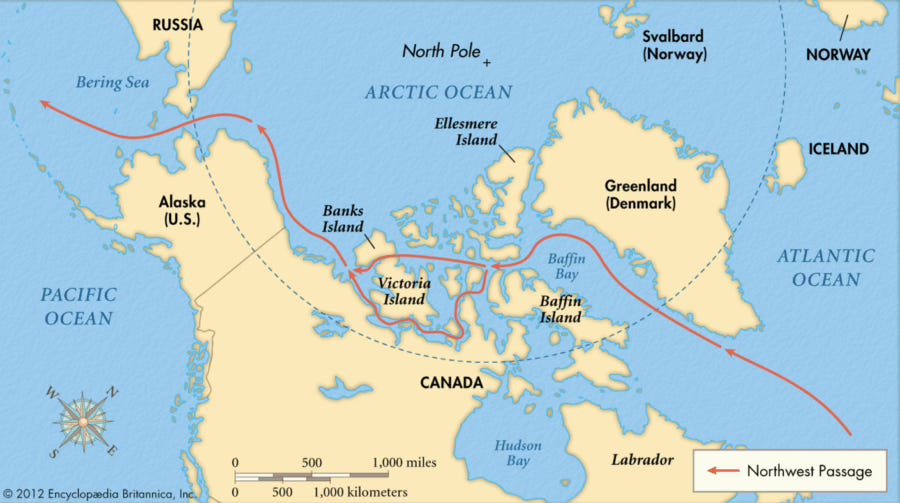
(Hypothetically) connecting Europe and Asia, the Northwest Passage was an icy route through the Arctic that had been the obsession of empires for centuries. Finding this path would expedite trade and prove maritime superiority, two things empires love to do.
And so in 1845, the British ships Terror and Erebus set out on the Franklin Expedition, named for its captain Lord John Franklin. With a crew of 129 men, 3 years’ worth of food, 1000 books, live cattle, and a few fun little pets to keep things interesting (like a monkey named Jacko), the men were well prepared for a long journey.
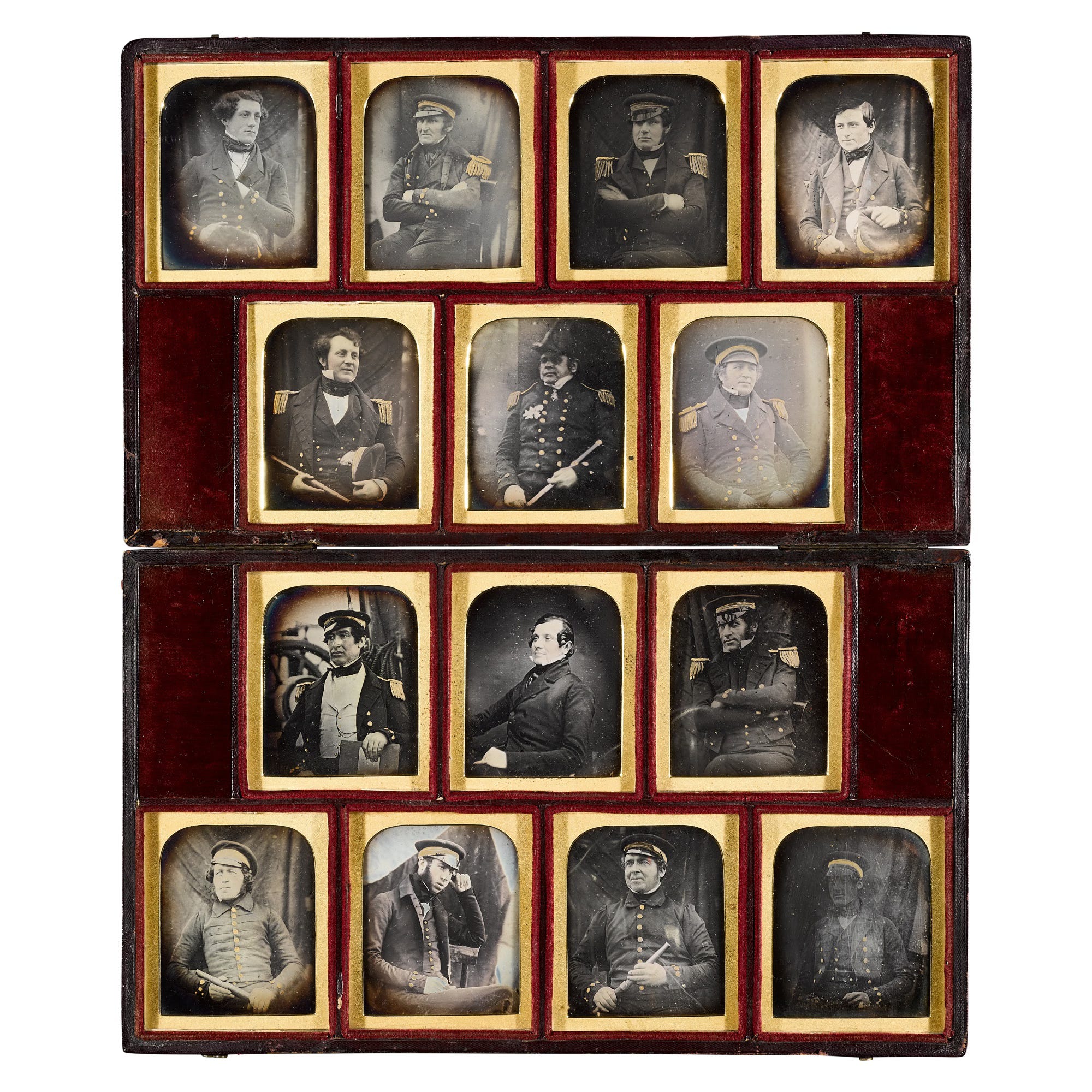
But after two years passed with no sightings of the men or their ships, Franklin’s wife Lady Jane (honestly, wow) persuaded the government to launch what ended up being the largest rescue operation in naval history.

Between 1847 and 1859, 26 expeditions set out to find Franklin and his men. The Franklin Mystery became a national obsession, with the plight of Lady Jane even inspiring a song that quickly entered the lost ship pop canon (covered below by Sinead O’Connor).
But did it have to be such a mystery? Starting in 1857, Inuit had told search parties where the two ships had sunk. In some cases, they even went so far as to draw a map to illustrate the exact locations. I imagine the conversations went something like:
British: “We cannot find the ships! What a tragedy! If only there was someone who could tell us where to find the ships!”
Inuit: “Oh, the ships? They’re over there” (points).
British: “What? You couldn’t possibly know that. Oh god, if we could only find someone who knew anything about the ships!! All is lost, time to leave.”
It wasn’t until 2014 and 2016 that the ships were finally recovered... exactly where Inuit had said over 150 years before.
Piecing together reports from Inuit and the analysis of the remains of the men who were found (including one whose exhumed body was traumatically presented to me without warning on a historical website), it appears that really so many things happened to these poor men at once. Or maybe it was a more of a cascade. Either way, it was not ideal.
First, the ships got stuck in the frozen waters in the winter of 1846-47. Then, Franklin died semi-abruptly in June of ‘47. The following winter, 24 men died of illness (see below), and those remaining decided to abandon the ships to try to reach the mainland, most likely because at this point they were also very sick and going insane (literally! see below!!!).
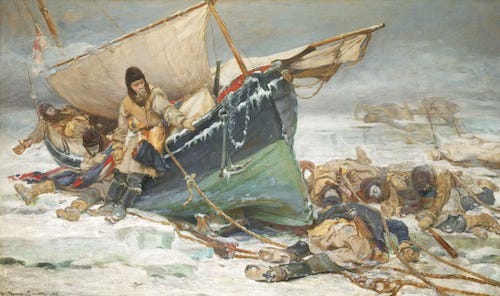
Sick with what, you might be wondering? Oh, there was scurvy, low zinc, tuberculosis, lead poisoning, botulism and starvation. In terrible luck, the tins of food appear to have been the cause of the lead poisoning, which makes you crazy. And when you’re navigating the arctic, you really want your wits about you.
There was also one rumor surrounding the fate of the men that was a bit hard to digest. Explorer (and so much more!) Dr. John Rae found crucial evidence related to the missing men by actually listening to Inuit. Unfortunately for everyone (except Inuit who didn’t really have a dog in this fight) the information was...not ideal.
It appeared that while the men had spared Jacko, their desperation had led them down the gristly path to cannibalism.
But when news of this spread, Lady Jane freaked out (understandable) and enlisted her pal Charles Dickens to write a real (long) hit piece on Dr. John Rae’s findings/Inuit generally.
The resulting scandal dogged Dr. Rae for the rest of his career, and may have even cost him a knighthood. But honestly, he seemed like a super cool guy so I bet he didn’t care that much.
The Franklin Mystery took over 150 years to fully solve. It was only in the 1980s that we learned about the lead poisoning that led (….) to the crew’s downfall, and the ships themselves weren’t found until shortly over a decade ago. This story provides two great lessons: 1. Never give up!!! 2. Wow ignoring Inuit is a real time waster.
Fun links:
History of the Northwest Passage here
A really wonderful site all about the expedition with primary sources here
Sinead O’Conner singing Lady Franklin’s Lament here
Dr. Rae’s report here
A very good/very Canadian video of an underwater exploration of the wreck here
An 80s documentary about the expedition called Buried in Ice -BEWARE YOU SEE OLD DEAD BODIES
*can I just say, doing these posts have made me realize how wonky history is. Almost every account I read of the various topics I’ve written about has conflicting information. They are mostly small details, like in this case the number of recovery expeditions that set out to find Franklin, but it’s just so interesting how hard it is to find one unified account of so many things.
Good day!